Losing a tooth changes more than your photographs. It changes how you chew, how you speak, how you hold your face in a conversation — and, over time, the actual structure of your jaw.
Dentures and bridges have been the standard answers for decades, and both still have legitimate roles. But dental implants solve a problem neither of them can touch. Here's the honest comparison, including the parts that go less discussed.
The problem nobody warns you about: your jaw starts disappearing
This is the single most important thing to understand about a missing tooth, and it's the reason implants exist.
Your jawbone doesn't maintain itself automatically. It maintains itself in response to mechanical stimulation — the forces transmitted down through your tooth roots every time you chew. Bone is living tissue that follows a use-it-or-lose-it rule.
Remove the root, and the bone in that area receives no signal to maintain itself. It begins to resorb.
The rate is faster than most people expect. Research on alveolar bone resorption consistently shows the majority of bone width loss at an extraction site occurs within the first year — commonly cited around 25% in the first year alone, continuing more slowly afterward.
Over years, with multiple missing teeth, the cumulative effect is visible in the face: the lower third shortens, the chin rotates forward, lips lose support and thin, and deep folds develop around the mouth. It's the characteristic "collapsed" appearance associated with long-term denture wearers — and it's structural, caused by bone loss, not by ageing skin.
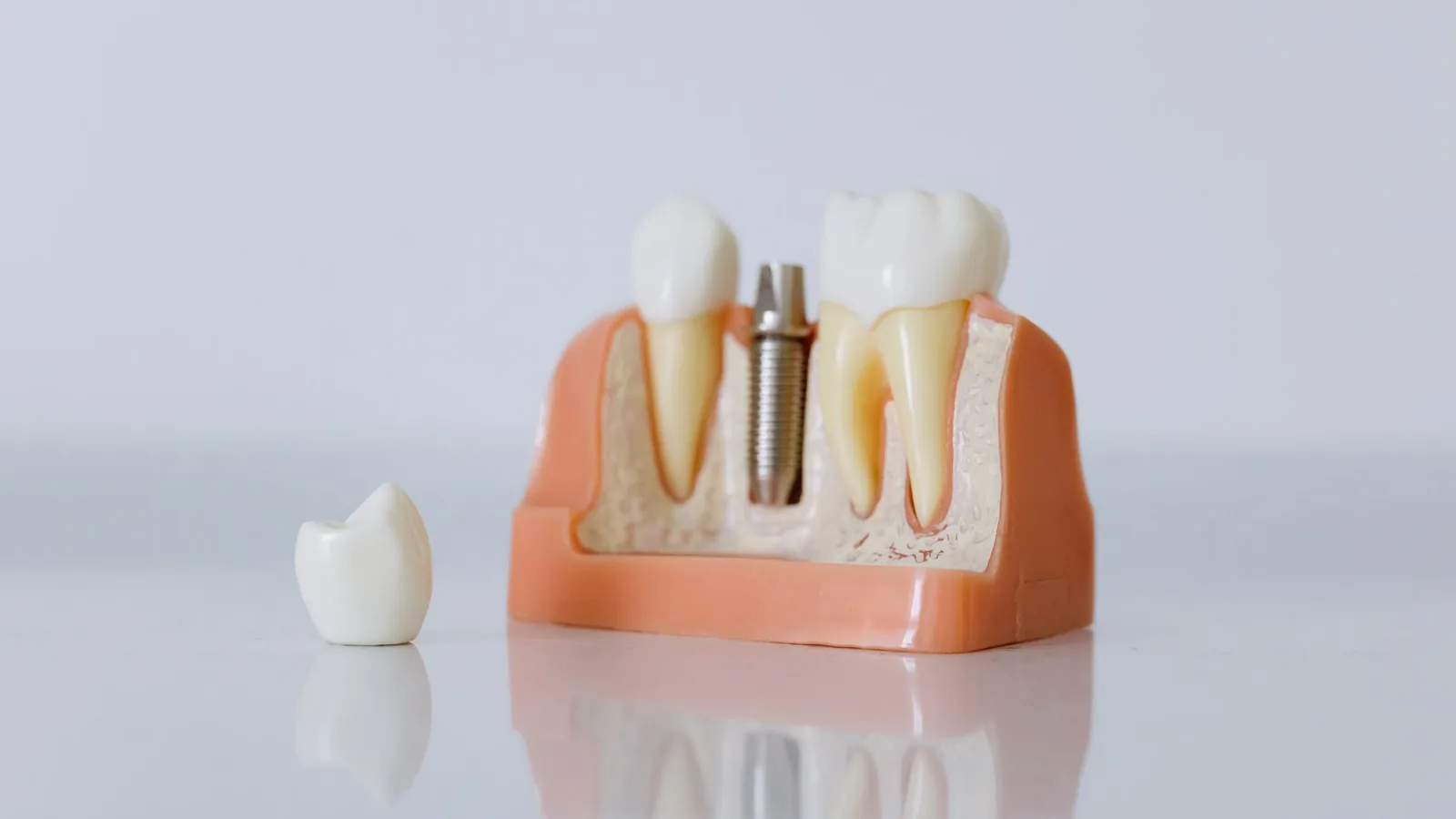
A dental implant is the only tooth replacement that stops this. The titanium fixture is placed into the bone and fuses with it through a biological process called osseointegration. Once integrated, chewing forces transmit through the implant into the bone exactly as they did through the natural root. The bone gets its signal and maintains itself.
Bridges and dentures sit on top of the gum. They restore the visible tooth. They do nothing whatsoever for the bone underneath, which continues to shrink.
The other things a gap does
- Neighbouring teeth drift. Teeth are held in position by contact with their neighbours. Remove one and the teeth on either side tilt into the space over months and years, while the opposing tooth in the other jaw over-erupts downward or upward. This creates new spaces that trap food, alters your bite, and can cause jaw joint discomfort.
- Chewing shifts to one side, overloading those teeth and increasing wear and fracture risk.
- Speech changes — front teeth in particular are involved in producing several consonant sounds.
- Diet narrows. People with missing teeth commonly avoid harder foods, which has real nutritional consequences over time.
Which is why "it's only one back tooth, nobody sees it" underestimates the situation. The visible part is the least of it.
The honest comparison
| Implant | Bridge | Denture | |
|---|---|---|---|
| Preserves jawbone | ✅ Yes | ❌ No | ❌ No |
| Affects healthy adjacent teeth | ✅ No | ❌ Requires filing them down | ✅ No |
| Chewing strength | Closest to natural | Good | Reduced |
| Typical lifespan | 20+ years, often lifetime for the fixture | 10–15 years | 5–10 years, needs relining as bone shrinks |
| Upfront cost | Highest | Moderate | Lowest |
| Time to complete | 3–6 months typically | 2–3 weeks | 2–4 weeks |
| Cleaning | Brush and floss normally | Requires threading under the bridge | Removed and cleaned separately |
| Requires adequate bone | Yes | No | No |
The bridge trade-off deserves emphasis. To place a traditional bridge, the dentist must grind down the healthy teeth on either side of the gap into small posts to support it. Two perfectly good teeth are permanently altered to replace one missing tooth. Those teeth then carry extra load, and if either later fails, the whole bridge fails with it.
An implant stands entirely on its own. Nothing else in your mouth is touched.
What the process actually involves
A realistic timeline, because "3 to 6 months" surprises people who expected a single appointment:
1. Consultation and CBCT scan. A 3D cone-beam scan measures bone height, width, and density, and maps the position of nerves and sinuses. This determines whether you have enough bone, and exactly where the implant can safely be placed. It is not optional for good implant dentistry.
2. Preparatory work, if needed. If bone volume is insufficient — common when a tooth has been missing for years — a bone graft or, in the upper back jaw, a sinus lift may be required first, with several months of healing before implant placement.
3. Implant placement. A minor surgical procedure under local anaesthetic, typically 30–60 minutes for a single implant. Most patients report less discomfort than they anticipated, and considerably less than a difficult extraction.
4. Osseointegration. The healing phase, typically 3 to 6 months, during which bone grows into and fuses with the implant surface. This cannot be rushed — it's biology, and it's what makes the implant permanent. A temporary tooth can usually be provided for the interim so you're not walking around with a gap.
5. Abutment and crown. The connector is attached and a custom crown, colour-matched to your surrounding teeth, is fitted.
Immediate loading — placing a temporary crown on the same day as the implant — is possible in some cases with good bone quality and stability, but it's case-dependent and not something to expect by default.
Who isn't a candidate
An honest article says this part too. Implants aren't right for everyone:
- Insufficient bone, unless grafting is possible
- Uncontrolled diabetes, which impairs healing and increases failure risk (well-controlled diabetes is generally fine)
- Heavy smoking, which significantly increases implant failure rates — many surgeons require cessation before proceeding
- Active periodontal disease, which must be treated first
- Growing patients whose jaws haven't finished developing
- Certain medications and medical conditions, particularly some bone medications and head-and-neck radiotherapy history
A proper consultation identifies these before anything begins. A clinic that promises implants to everyone without assessment isn't assessing.
They still need maintenance
Implants can't decay — there's no natural tooth structure to decay. But the gum and bone around them absolutely can become infected. Peri-implantitis is inflammation of the tissues surrounding an implant, and it's the leading cause of late implant failure.
It's prevented by exactly what you'd expect: brushing, flossing or interdental brushes around the implant, not smoking, and regular professional maintenance visits. An implant is not a maintenance-free tooth. It's a tooth that will last decades if you look after it.
Cost in Egypt (2026)
Egypt is among the most cost-effective places in the world for quality implant treatment, which is why implant tourism here is significant. Market ranges as of 2026:
| Typical range | |
|---|---|
| Single implant fixture (mid-range brand) | ~12,000–18,000 EGP |
| Single implant (premium Swiss/European brand) | ~25,000–42,000 EGP |
| Crown | often priced separately, ~3,000–8,000 EGP |
| Bone graft / sinus lift | ~2,000–8,000+ EGP additional |
| Full arch (All-on-4 / All-on-6) | ~75,000–210,000 EGP per jaw |
For comparison, a single implant in the United States typically runs $3,000–$6,500, and in the Gulf and Europe substantially more than in Egypt — using the same implant systems from the same manufacturers.
What actually changes your price: the implant brand and system, whether grafting is needed, the crown material, the imaging and planning technology used, and the surgeon's experience. Ask for an itemised written treatment plan that specifies which implant system is being used and whether the crown, abutment, imaging, and follow-ups are included. Quotes that bundle everything into one number make comparison impossible.
Find out what's possible for your case
Whether an implant is right for you comes down to your bone, your gum health, your medical history, and your goals — and the only way to know is a scan and an examination.
Book an implant consultation at Reedy Dental Clinic at one of our Suez branches. We'll take the imaging, tell you honestly whether you're a candidate and whether grafting is needed, and give you a written, itemised plan with the implant system named and the costs laid out clearly.
The sooner you're assessed, the more bone there is to work with.